

Firemap
A real-time view of payment provider health across the global payments ecosystem. Learn more about Firemap in the docs Last updated just now
Number of incidents Incidents timeline
105 peak
105 peak
105 peak
- Operational
- Degraded
- Partial outage
- Major outage
- Community report
Categories
Counts reflect providers with discovered, parsed, and tested official status sources.

Stay on top of your payment stack
Add your payment providers to Stack and get updates on incidents, outages and service status changes in one place.
- Monitor the providers you rely on
- Get notified about status changes
- Spot issues before they affect your payments
Missing a Provider?
Request any provider and we'll add it to our monitoring.

Providers with active issues
Last 30 days
Counts reflect providers with discovered, parsed, and tested official status sources.
- PPRO Partial outage 4 active incidents Partial outage: [External] Credit Card - Brazil | | Partial Service Degradation Monitoring
- Flutterwave Partial outage 5 active incidents Partial outage: [NGN] Service Alert: MTN Airtime Purchase Disruption Identified


Payment Ecosystem Health
Aggregated status of all payment providers tracked by Firemap.
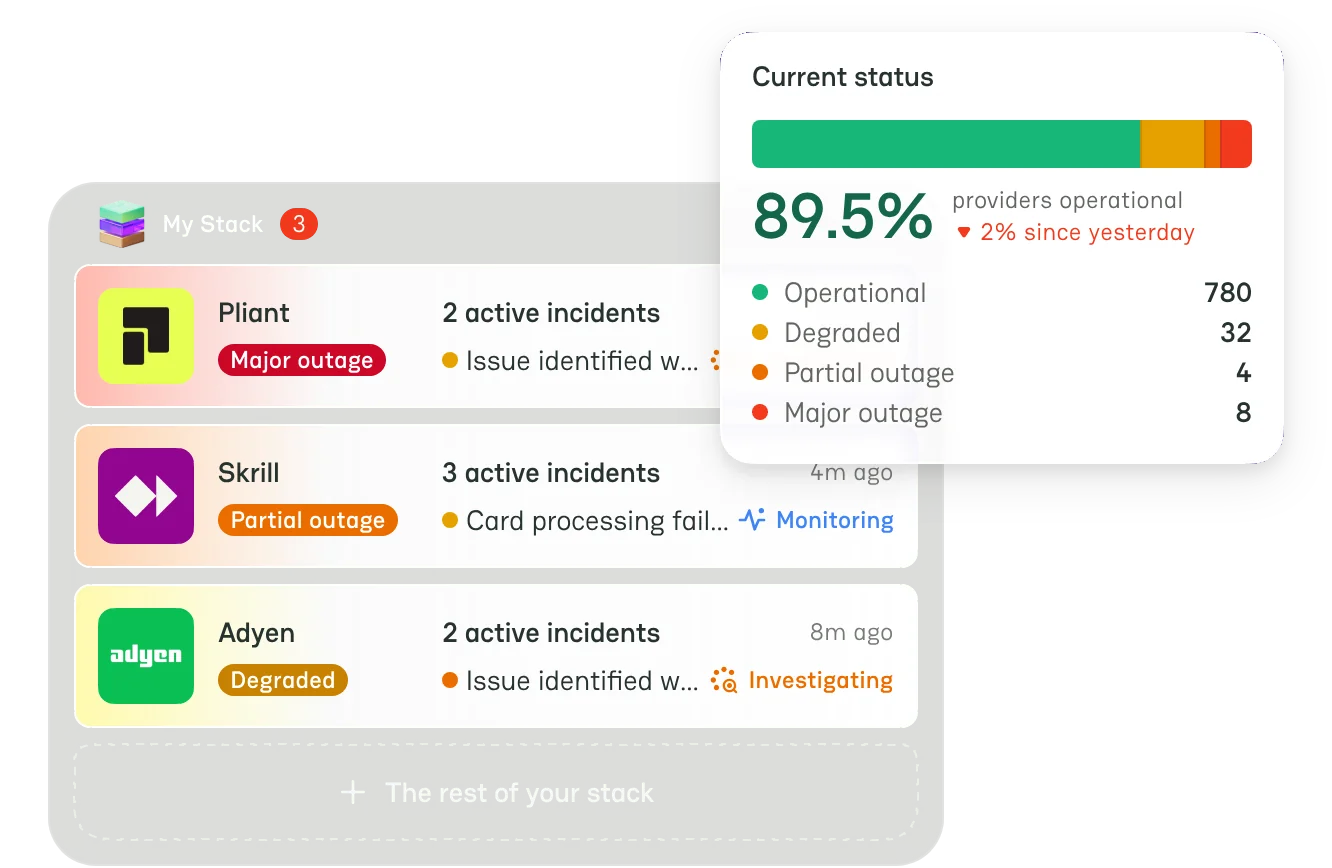
- Operational 188
- Degraded 7
- Partial outage 12
- Major outage 2
Recent community reports
- Last 24h
- 0
- Last 7d
- 3
- Last 30d
- 14
- Backoffice not up to date. Its usually almost instant. Epos Now
- Top up is not available in the app or website Worldfirst
- Top up feature showing interface error so unable to top up my AUD account. It has been like this for over 24 hours Worldfirst
- Eposnow is completely down, backend api included Epos Now
- Withdrawals affected by payments network outage. XAPO


Why Firemap
Payment infrastructure is fragmented. So is its operational visibility.
-
Your providers can fail
A payment issue can start with a provider, even when your own systems are working.
-
Updates are scattered
Providers publish status in different places, formats, and at different times.
-
No shared picture
Your team has to find and assess those updates before deciding where to focus.
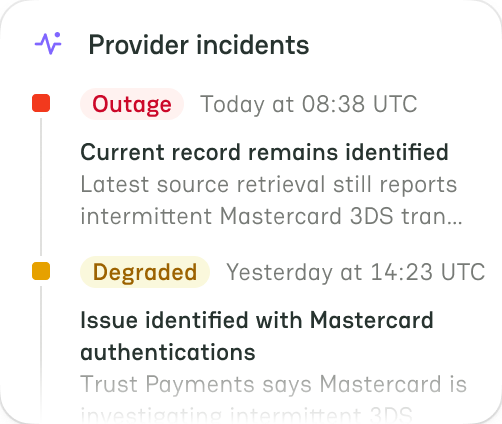

Firemap brings provider updates together
See published status and incident updates in one consistent view, with each source and update time shown.
How it works
From thousands of status updates to one normalized view.
-
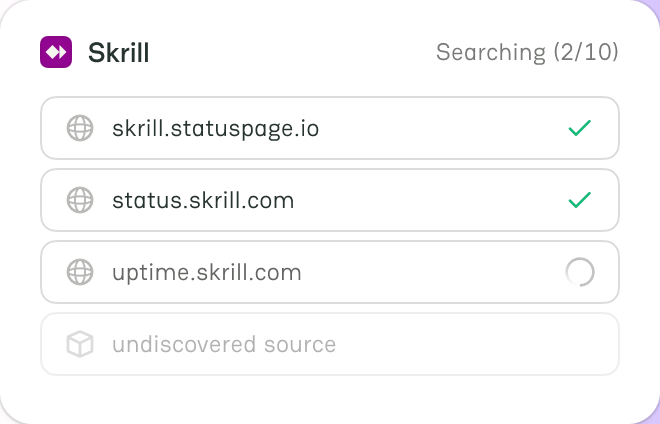
Find public status sources
Firemap finds publicly available status pages and feeds from payment providers.
- Find official provider status sources.
- Cover pages and feeds across providers.
- Establish the basis for status tracking.
-
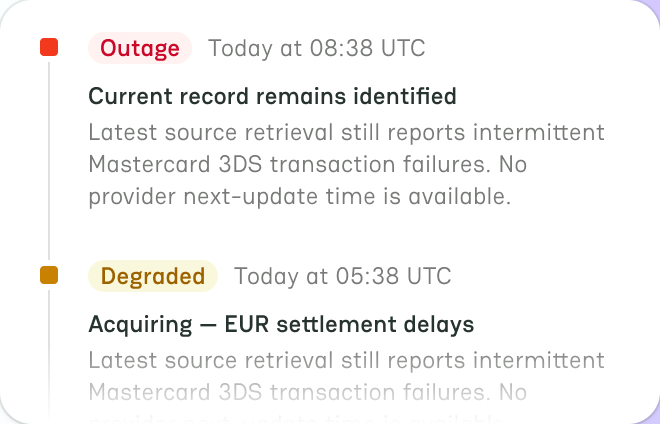
Gather provider updates
Firemap continuously collects status changes, incidents, and incident updates.
- Capture incidents and their updates.
- Detect newly published status changes.
- Consolidate updates from multiple sources.
-
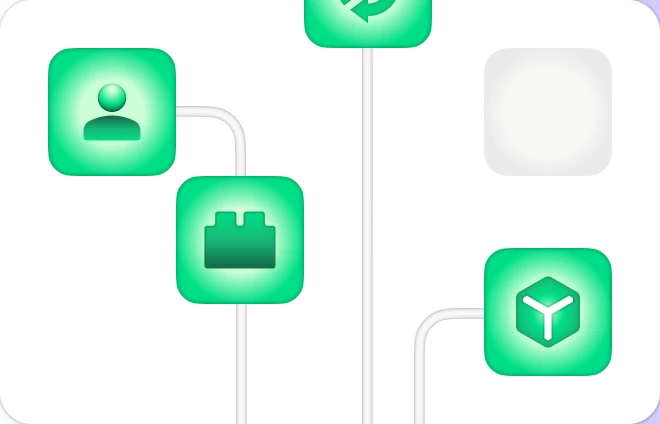
Bring different formats together
Firemap maps different provider formats into one consistent reusable data model.
- Standardize provider-specific status formats.
- Turn raw updates into structured data.
- Make incidents easier to compare.
-
Keep provider status current
Firemap tracks changes over time and keeps status data up to date.
- Track provider health over time.
- Keep status information up to date.
- Reveal disruptions across payment providers.
-
Connected to the source
Every status and incident comes from the provider's own status page.
-
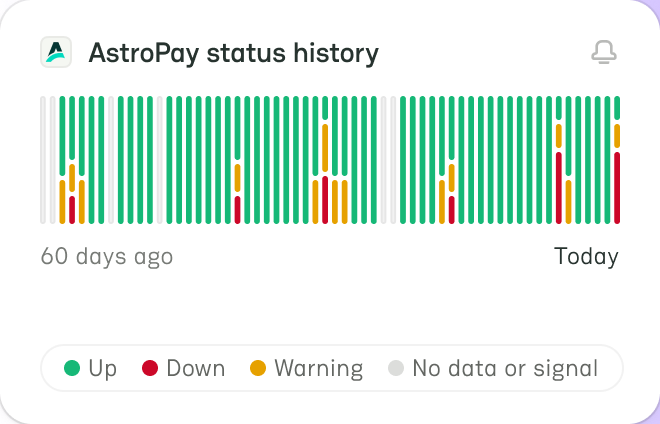
Review incident history
Look back at a provider's past incidents and recurring patterns.
-
Reports from real customers
Report your current incident or ask to add a missing provider.
-
Follow an incident
See each update of an incident, from first notice to resolution.
Firemap FAQ
Firemap watches the public status pages of the payment providers listed on PayAtlas and brings what they report into one place.
It does not replace a provider status page — it reads it, so you can follow the whole ecosystem at once.
Every status and official incident comes from the provider's own status page or its feed, read automatically. Nothing is entered by hand, so a provider that has not reported a problem is shown as operational.
Community reports come from PayAtlas users. They appear in their own blocks and never change the official status of a provider.
They are the four status levels Firemap uses, the same scale most status pages use. Operational means everything works normally. Degraded means the services work, but some are slower or return more errors than usual. Partial outage means some services, regions or payment methods are unavailable, while the rest still work. Major outage means a key service is unavailable for most customers.
The wording on each status page belongs to the provider; Firemap maps it onto these levels so that providers can be read side by side. When the provider publishes it, an incident also shows its stage: Investigating, Identified, Monitoring or Resolved.
One column for each day: 90 days on a wide screen, 60 on a smaller one, and 30 on a narrow screen. Each column shows the official incidents that started that day by level, measured against the busiest day on screen: that day fills its whole column, and a quieter day fills it in proportion. The rest of the column is green, so a fully green column is a day without incidents.
A purple strip at the bottom marks a day with community reports. On a computer, hover a column to see how many providers were on each level that day, and click it to list the providers that had issues on that day.
The list shows the providers with official incidents or community reports in the last 30 days, one card for each provider. Active lists the providers with an open incident that started in the last 30 days; Resolved lists the rest. Most affected puts first the providers with the most severe, longest and most recent incidents; on Resolved, you can also sort by when the incident was resolved, by duration, by impact or by the number of reports.
A level, a category or a day on the Incidents timeline narrows the list. Select a card to open a panel with the current status of the provider, its incidents and its community reports.
How many of the providers that Firemap tracks are on each status level right now, and the share of them that are operational. The share is rounded down, so a single provider in trouble keeps it below 100%. A provider whose status page Firemap has not read yet counts as operational.
A community report is a problem that a PayAtlas user saw with a provider. Recent community reports shows how many reports were published in the last 24 hours, 7 days and 30 days, and the latest ones; select a report to open the panel of its provider.
To send a report, use Report an incident, sign in, choose the provider and what you see, and describe the problem. The report appears at once.
Firemap checks each tracked status page every few minutes.
The provider list, Payment Ecosystem Health and the category numbers on this page follow within about 10 minutes, and the Incidents timeline within about an hour. A published community report appears in Recent community reports at once.
Yes. Request the provider and it joins the monitoring as soon as its status page is found.
Providers already listed on PayAtlas are picked up on their own once they publish a status page.